14 August Poetry: Verses That Move a Nation
Every year, as the calendar turns toward mid-August, something changes in the air across Pakistan. Green and white bunting appears on balconies and somewhere a grandfather is teaching a child the opening lines of a patriotic poem he memorized in school decades ago.
That’s the real power of 14 august poetry. It isn’t just classroom material trotted out once a year. It’s a living thread connecting generations, carrying the emotion of independence forward long after the fireworks fade.
This piece is a complete guide to that tradition: where it comes from, who shaped it, how to use it for a 14 august 2026 celebration, and how students, teachers, and everyday readers can actually connect with it instead of just reciting it.
14 August Poetry on Unfulfilled Promises
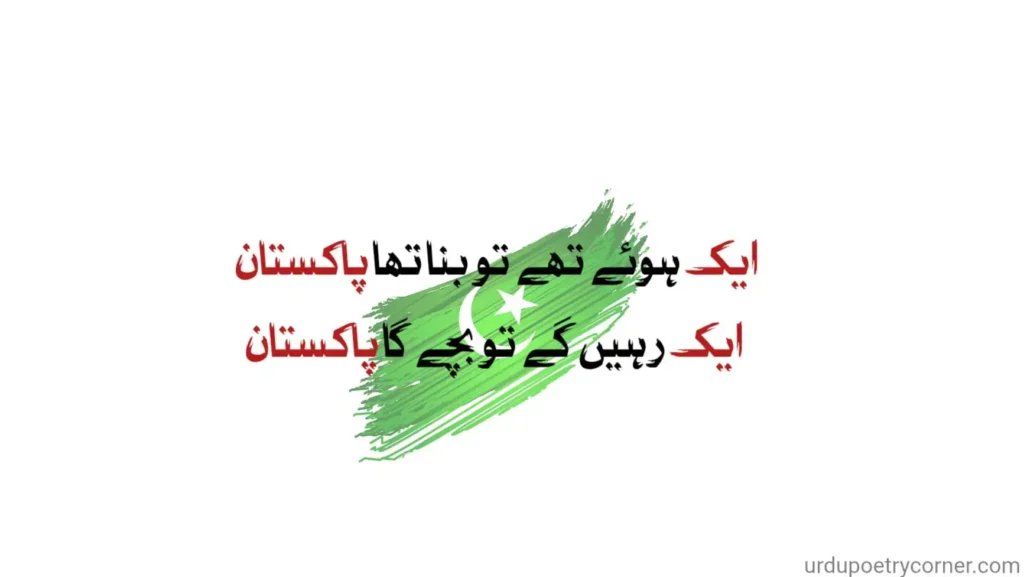
Not every 14 august poetry in urdu 2 lines written to celebrate. A significant strand of this tradition turns inward, questioning whether the dream of 1947 has actually been realized. These verses speak of a freedom still waited on, promises made to the generation of Partition that remain only half kept, and a nation that, even after decades, hasn’t fully found its footing.
Read together, they offer a more honest, complicated portrait of independence than pure celebration ever could.
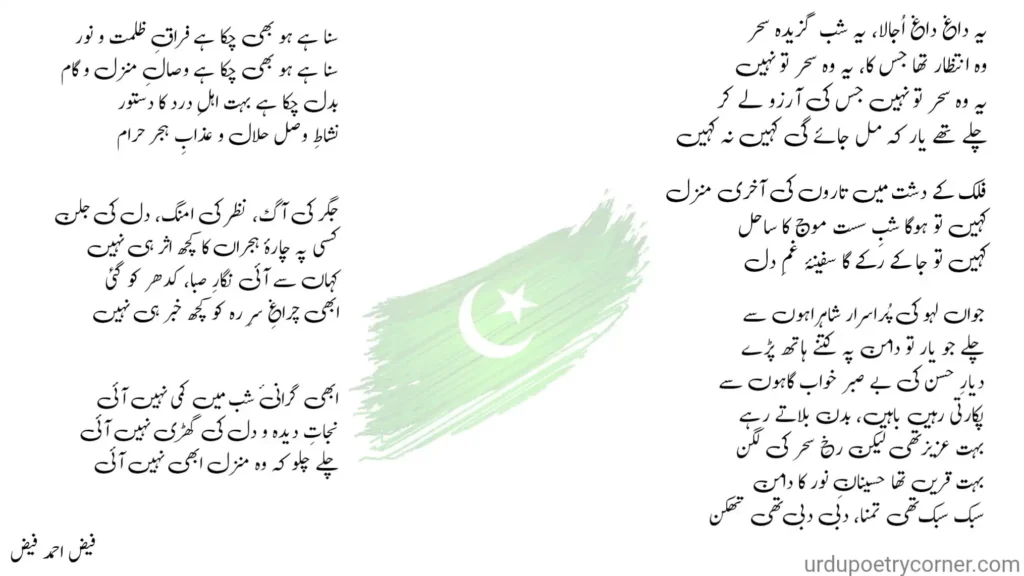
Faiz Ahmed Faiz’s 14 August Nazam: “Subh-e-Azadi”
Faiz Ahmed Faiz’s “Subh-e-Azadi,” often referred to by its opening image of a stained, wounded dawn, remains one of the most debated pieces of 14 august nazam writing in Urdu literature. Written in the immediate aftermath of Partition, it refuses the easy language of celebration and instead asks whether the freedom so many died for had actually arrived in its promised form. That willingness to question, rather than simply praise, is exactly what has kept the poem relevant and widely taught nearly eight decades on. here is full nazam with tashreah.
14 August Poetry Difference From Other Patriotic Writing
At its core, this is poetry written to capture the emotional weight of a specific historical rupture (the birth of Pakistan on 14 August 1947) and the ongoing question of what that freedom means. Unlike generic patriotic verse, the best examples don’t just celebrate; they interrogate. They ask what was sacrificed, what was promised, and what remains unfinished. That tension is why these poems still land with force nearly eighty years later, rather than feeling like museum pieces.
The genre draws heavily from classical Urdu forms. The ghazal’s structure occasionally, but far more often the nazm, a poem built around a single unified theme rather than a chain of loosely connected couplets. A 14 august nazam typically follows a clear emotional arc: struggle, sacrifice, arrival, and responsibility. That arc mirrors the actual historical experience of Partition and independence, which is part of why the form suits the subject so well.
Poets Behind Pakistan Independence Day Poetry
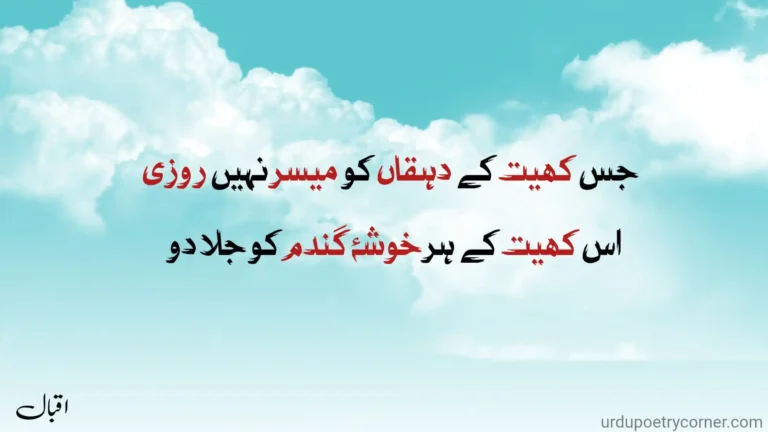
Allama Iqbal is the name most people reach for first, even though he passed away nearly a decade before independence itself. His verses on selfhood, aspiration, and the idea of a homeland became the philosophical scaffolding that later poets built on. Faiz Ahmed Faiz took a very different, more critical angle — his poem written on the night of independence questions whether the promised dawn had truly arrived, a perspective that surprised many readers expecting pure celebration and still sparks debate in literature classes today.
Hafeez Jalandhari, remembered for writing Pakistan’s national anthem, brought a more formal, ceremonial register to patriotic verse. Josh Malihabadi, often called the “poet of revolution,” infused his independence-era work with urgency and fire. Reading these figures side by side is genuinely instructive. It shows that independence day poetry in urdu was never a single unified voice. independence day poetry was, and still is, a conversation with real disagreement inside it.
14 August Shayari for a Specific Occasion
This is where a lot of people get stuck, because “14 august shayari” covers a wide emotional range from solemn to celebratory to defiant. A school assembly needs something different than a family WhatsApp group or an Instagram caption.
A few practical guidelines for 14 august poetry:
- For formal school or college events, favor structured nazms with a clear beginning and resolution rather than short couplets, since they hold an audience’s attention longer.
- For social media captions, two line shers work better than full nazms. They are shareable and easy to read in a single glance.
- For personal reflection, look toward the more questioning, less triumphant poems. They tend to say something truer about how independence actually feels decades later, rather than flattening it into pure celebration.
- Match tone to audience age. Younger children respond to rhythm and repetition; older students and adults engage more with poems that carry historical or philosophical weight.
14 August Poetry for Students
Curated collections for students exist for a good reason: not every powerful poem is age appropriate or easy to recite from a stage. A poem chosen for a Grade 3 assembly needs simple vocabulary, a strong rhythm, and an uplifting close. A poem for a college debate or literary society, on the other hand, can carry the weightier, more critical tone found in Faiz’s work.
Teachers preparing material for 14 august 2026 events would do well to build a small tiered list — one set of shorter, rhythmic poems for younger students, and a second set of longer, more reflective nazms for senior classes. This isn’t just pedagogically sound; it also keeps the tradition from becoming rote. A child who is handed a poem slightly beyond their comfort level, with guidance, often engages with it far more genuinely than one handed something too simple to feel meaningful.
Evolution of 14 august poetry in urdu
The tradition hasn’t stood still. Spoken word and slam poetry events now run alongside traditional recitation competitions, especially in university settings. Social media has changed distribution entirely. A well written two line sher can now reach more readers in a single day than a printed anthology reached in a year. This has actually revived interest in shorter forms, since they suit the scroll and share rhythm of platforms like Instagram and Twitter.
There’s also a growing appetite for poems that engage honestly with present day challenges like economic hardship, political disillusionment and hope for the next generation, rather than only recycling 1947 era imagery. This mirrors Faiz original instinct to question rather than simply celebrate, suggesting the genre is returning, in some ways, to its more complex roots. For the ease, to be understand outside pakistan 14 august poetry in urdu two lines is somehow replaced by roman urdu format.
A Tradition Worth Carrying Forward
14 August poetry endures because it does something few other national traditions manage: it holds celebration and critique in the same breath. Whether you’re a teacher building a lesson plan, a student preparing a recitation, or simply someone looking for the right words to share on 14 august 2026, the richness of this tradition offers something for every register — solemn, joyful, questioning, and proud, often all at once.
Everyone of you and me knows the situation of pakistan but their only solution is